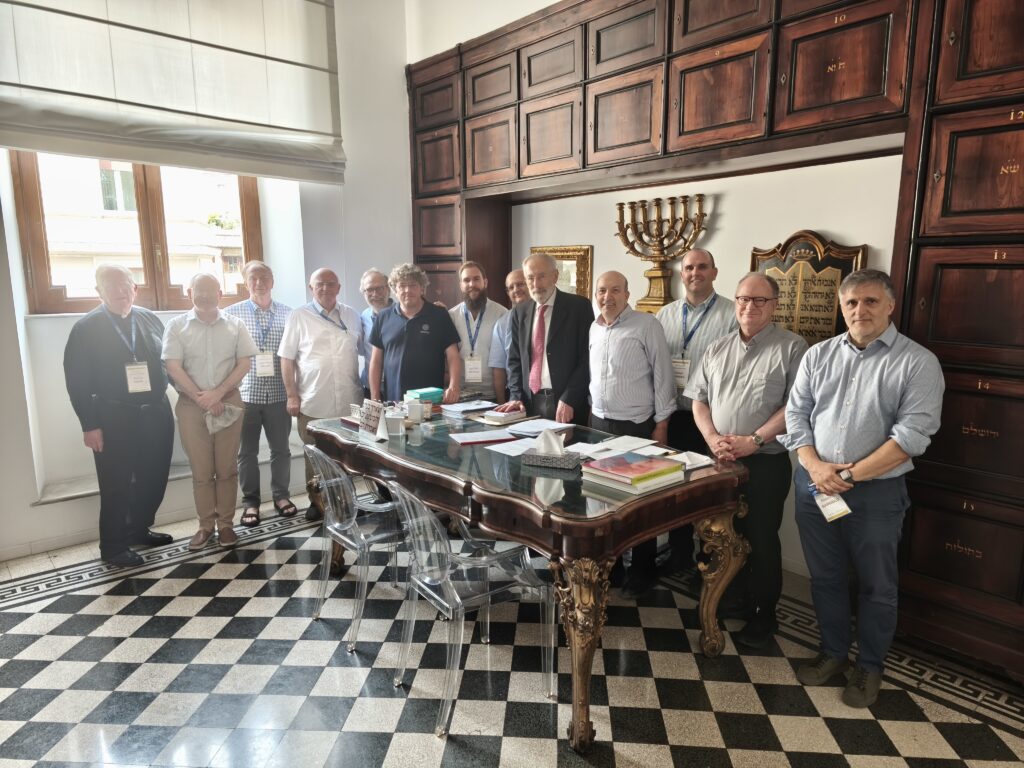
Fourteen Jesuits involved in dialogue with Judaism gathered in Rome from June 28 to July 1, 2026.
Uses and Abuses of Memory
In the Bible and in rabbinic tradition, memory is the very essence of existence. «Remember that you were a slave in the land of Egypt,» Moses tells the people in Deut 5:15. The Baal Shem Tov, founder of Hasidism, famously taught: «Forgetfulness leads to exile, while remembrance is the secret of redemption.» Yet memory, vital as it is, can also be distorted and turned into an ideological tool, whether in the religious, social, or political sphere. To reflect on this theme, the Jesuits engaged in dialogue with Judaism gathered at the General Curia in Rome for three days of discussion. The meeting was organized by Francisco Martins, SJ, James Hanvey, SJ, and Massimo Gargiulo, director of the Cardinal Bea Centre for Judaic Studies at the Pontifical Gregorian University in Rome.
The first congress of Jesuits working in the field of Jewish-Christian relations was held in Krakow, Poland, from December 27 to 31, 1998, at the initiative of the then Superior General of the Society, Peter-Hans Kolvenbach, alongside other Jesuit networks focused on Islam, Buddhism, and Hinduism. Since then, the group has met approximately every two years in various locations, from Jerusalem to major centers of the Jewish diaspora.
Remembering in Rome: A Jewish City
For the first time, the meeting was held in Rome. Rome had been a Jewish city for twenty-two centuries, two centuries before it became a Christian city. The Chief Rabbi of Rome, Riccardo Di Segni, reminded us of this when he welcomed us warmly to his office at the Great Synagogue. It was June 30, the day after the feast of Saints Peter and Paul, and the Chief Rabbi did not fail to mention two «dissident» Jews who arrived in Rome in the middle of the first century: Paul and Peter. Rav Di Segni gave an impressive account of the history of Rome’s Jewish community, paying particular attention to its darkest moments, from the exactions of the Inquisition – including the burning of the Talmud in 1553 – to the barbaric measures of the Nazi occupation, especially the deportation of 1,023 Jews from Rome to Auschwitz on October 16, 1943. The Chief Rabbi expressed both his appreciation for the Jesuits and his expectations of them, expectations that have not always been met, referring us to the turning point marked by the Second Vatican Council’s declaration Nostra Aetate. His confidence was inspiring.
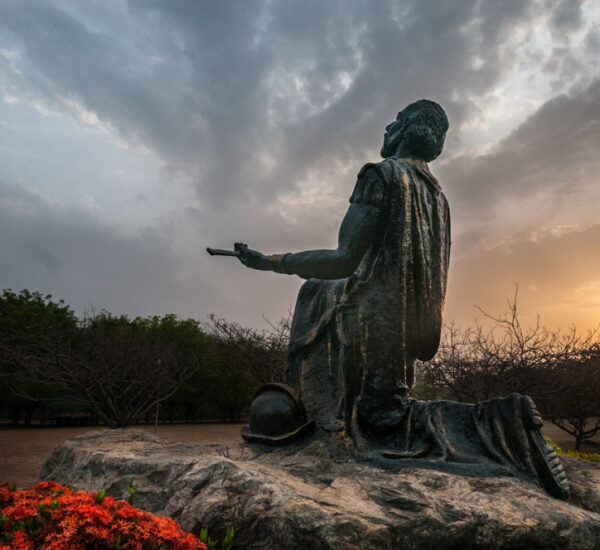
In keeping with the imperative to remember, we spent a long time at the site of the Fosse Ardeatine. The Ardeatine massacre was the mass killing of 335 civilians and political prisoners carried out in Rome on March 24, 1944, by German occupation troops in reprisal for a resistance attack. Seventy-five of the victims were Jews, rounded up simply because they were Jewish.
Purifying our memory: Face to Face Encounters
Our reflection on the ethics of memory continued as we listened to our hosts, beginning with the Jewish historian Anna Foa of Sapienza University of Rome, a specialist in the history of the Jewish diaspora and the author, among other works, of the controversial essay Il suicidio di Israele (2024), on Israel after October 7, 2023, and the war in Gaza. Anna Foa’s call to rebuild Israeli democracy beyond the nationalist and messianic options of the current government, and with a view to a two-state solution, is both courageous and coherent. The Jewish psychologist David Meghnagi of Roma Tre University offered further perspectives, emphasizing the place of the State of Israel within postcolonial history.
With Alejandro Dieguez’s contribution, we shifted our focus to the ad intra dimension of memory. Alejandro Dieguez is currently responsible for the archives of Pope Pius XII at the Vatican Apostolic Archives. The opening of those archives in March 2020 has not settled the dispute between those who criticize Pius XII’s stance during the persecution of the Jews in the Second World War and those who defend it. Alejandro Dieguez made this point clearly: the debate will not be resolved by the discovery of a single document. What matters is the overall – and at times internally contrasted – portrait of Pope Pacelli. In that portrait, one must not overlook the instructions he gave to Catholic institutions in Rome to hide Jews; the Pontifical Biblical Institute was one of them.
A fraternal meeting with Father General Arturo Sosa focused in particular on the role of the Jesuit house in Jerusalem, in the spirit of the letter he wrote in December 2025. That house is a concentrated expression of the mission of the whole Society to serve reconciliation, and pilgrimage is a central dimension of both Ignatius’s life and the life of the Society. James Hanvey, Secretary for the Service of Faith at the Curia, helped us connect our work with the Society’s overall commitment for faith. Even though Jesuit provinces – or even entire conferences – may show differing levels of interest in Judaism, simply because some have no Jewish community in their territory, every Jesuit encounters Judaism through the person of Jesus.
Our final guest was Rabbi David Meyer, who teaches at the Cardinal Bea Centre in Rome. In his plea for cura personalis in our approach to teaching, we realized how well Jesuits and Jews can get along. But he also added a sober note: both Judaism and the Society of Jesus are facing challenging times because of the decline in the number of young people trained in the complexity of their respective traditions. These are also dark times in many parts of the world, starting with the Middle East. In such times, we must hold on together for the sake of future generations—and remain people of memory and hope.