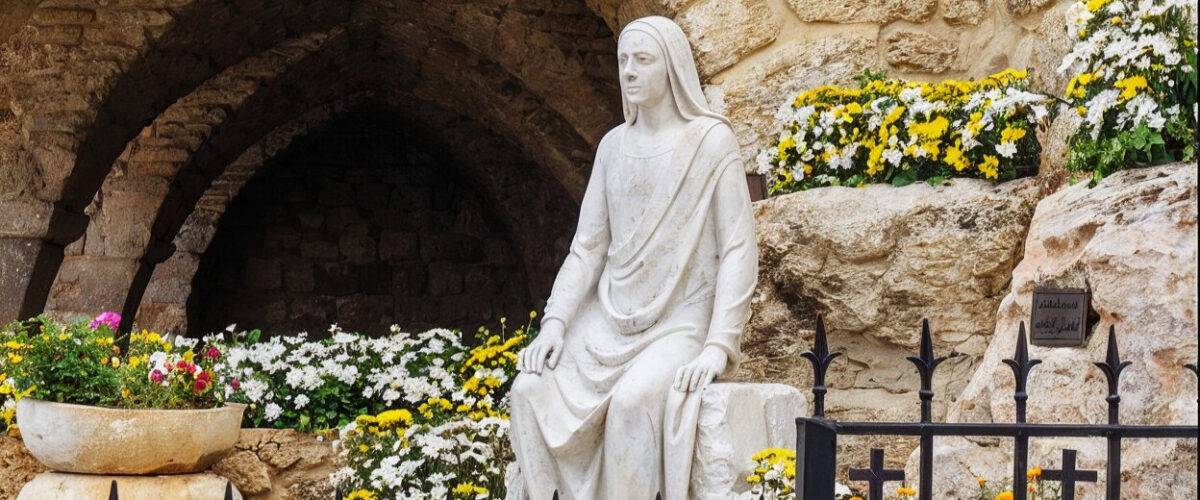
In South Lebanon, on the heights above the City of Sidon, there is a famous pilgrimage site dedicated to “Our Lady of Awaiting” (Saydet al Mantara in Arabic). Popular traditions say that the Virgin Mary, while accompanying Jesus and his disciples who went to preach in the pagan lands near Tyre and Sidon, awaited their return in that place (Luke 6:17-19; Matthew 4:24-25).
I really like this place. Everything leads us to feel that Mary is fully focused, leaning forward, attentive, searching for the slightest sign in expectation of her Son’s return and that of the disciples. Waiting becomes synonymous of desire, hope, communion and prayer.
Mary is not only the Mother of Christ, but also the Mother of all believers. On the Cross, Jesus entrusts Mary to the beloved disciple John, saying, “Woman, behold your son” (John 19:26); then, Jesus says to the disciple, “Behold your mother” (John 19:27). This is why, on the inscription above the statue, at the entrance to the grotto where Mary was supposed to be waiting for Jesus and for the disciples, we can read, “I am waiting for my children”.
Saydet al Mantara, above Sidon, South Lebanon
Awaiting
Waiting is often associated with passivity. Waiting is never convenient. Waiting can be indefinite, nerve-racking, exhausting, even hopeless.
However, as we know, he who expects nothing, hopes for nothing and obtains nothing.
On the other hand, awaiting is what gives rise to desire, calling it into being.
In a certain manner, Mary’s expectation, her hope and that of her people led to the Incarnation of the Son (we may even say ‘made it happen’), “when the time was fulfilled” (Galatians 4:4).
Such an expectation is the opposite of passivity. Even when there is misunderstanding and doubt, even in the midst of suffering, awaiting is a sign of trust and hope: “As for Mary, she kept all these things and pondered them in her heart (Luke 2:19).
Meditating, praying, is “Waiting in Hope”. The Advent season is the season of authentic waiting par excellence.