‘Collaborating, with Gospel depth, for the protection and renewal of God’s creation’
Society of Jesus, Universal Apostolic Preference 4.
Summary: This essay explores the need for a renewed theology and spirituality of creation in light of the current ecological crisis, arguing that the Spiritual Exercises of St Ignatius of Loyola offer a valuable resource for this renewal. Here, I suggest moving beyond sterile debates between creationism and evolution or a science that reduces the ecosphere to an ‘object’ and call for an expanded epistemology and ontology that appreciates the spiritual nature and interconnectedness of all life forms, recognising that the cosmos exists within a ‘dynamic transcendence’ immanent to all things. Ignatius’ perspective likewise recognises the soteriological work of creation and its participation in God’s salvific purpose—creation, too, has its mission. The verbs in §60—‘permitted me to live, has sustained me in life; tolerated me, guarded me, and prayed for me’ (my emphasis)—reveal that creation performs its mission of manifesting God’s saving love and is a ‘genuine home for us’. Creation’s fidelity is ordered to the Incarnation and lives in the hope of the Resurrection. The Resurrection, still carrying the memory of the cross, is critical, presenting a new epistemological, ontological, and ethical reality. It initiates an ‘epistemology of love’, a ‘graced knowing’ that is a whole-person, relational activity rooted in humility, gratitude, and a vocation of service. The Contemplatio ad Amoremis the consolidation of this grace, becoming a habitual way of encountering God. The ‘labouring and working’ of God considered in the Contemplatio is His continuing work of redemption, in which we are made agents and apostles of Christ. The gift of a healed and restored freedom, which is relational and realised in service, calls us to choose the good of the whole community of creation.
Introduction
In the present ecological emergency there is a renewed attention to the theology and spirituality of creation.[1] Although there is great richness in the Christian tradition, especially in its spiritual traditions, the challenge for theology is to get beyond the now rather sterile debates between creationism and evolution on the one hand, and a science which reduces the whole ecosphere to an ‘object’ over which humans strive for instrumental mastery. In this regard, religion has also played its part. In the light of our scientific knowledge, not only of the natural world but also of other animal ecologies,we need a theology of creation that is more complete and that furnishes humanity with a deeper understanding of its vocation to the whole ecosphere.[2] There is certainly a need to develop an ecological ethics that goes beyond necessity to a recalibration of our place in the natural world and a reordering of our relationships beyond economics, politics and exploitation for human benefit at the expense of other systems of life.[3] Even more than this, however, and prior to it (or at least going hand in hand) we need to set aside our prejudices and come to a more expansive epistemology and ontology that appreciates the spiritual nature of all life forms and its interconnectedness; that the life of the cosmos exists within a dynamic transcendence immanent to all things and all degrees of being. This means that nothing is purely for itself, and nothing is sufficient in itself. This is implicit in the very nature of being created.
In exploring and testing the validity of this understanding, ecology forms a useful and urgent field of co-operation between religions, and especially between believers and non-believers. It is remarkable how many ecological movementsrecognise the need to root their positions in spirituality (theist or non-theist), which can bring about and sustain the change in personal, political, economic and cultural systems. Despite President Trump’s claims that climate change is a ‘con job’ and green energy is a ‘scam’, people recognise the vested interests of an exploitive capitalism that is largely self-serving.[4]
Although the recovery of a Christian theology of creation has brought many new and pertinent insights for developing an integral ecology, most fail to start from the reality of the resurrection’s restoration of creation and the human place within it that it brings. The resurrection is not only a radically alternative to our own present understanding, especially its limits, but it also discloses a new reality within time and matter that is not alien to them but nonetheless closed to us. As the starting point for a theology of creation, the resurrection requires a wholly new approach to ontology and temporality. It requires us to inhabit creation in a transformed way and be aware of the new potentialities for life and creativity that it brings.
Obviously, such a theology requires a much more substantial treatment than is possible in this brief essay, but I want to suggest that a resource for such a renewed theology of creation lies in the Spiritual Exercises, especially in its presentation of the resurrection and the Contemplatio ad Amorem.
Ignatius and Creation:
We would search very hard in writings of St Ignatius to find a rapturous hymn of praise like Laudato Si composed by St Francis. That does not mean that Ignatius is not aware of creation. One of the popular hallmarks of Ignatius’ spirituality, the rather over-worked mantra of ‘finding God in all things’, certainly suggests that he does have an appreciation of the natural world and God’s presence in it.[5]
One of the most common expressions for God found in his writings is ‘Creator and Lord’. It is deceptively simple, and it would be easy to overlook its ‘saturated’ quality. Ignatius is remarkably consistent in his way of speaking and referring to God, and his expression is always grounded in the experience that it also invokes.[6] Naming God this way is not rhetorical, nor does it reflect a formal theological formula. Rather, it describes and creates a relational space of encounter with God as immanent as well as transcendent; it presupposes the whole process of the Exercises. So, when it occurs in Ignatius’ writings, whether in formal public texts like the Constitutions or routine correspondence, it has a performative and evocative purpose. For the Exercises, the experience of God the Creator and God (Jesus Christ) the Lord and saviourare inseparable, and they are united in the cross.[7] To know and love God is to know and love Him under both aspects and to understand their unity as Christologically and pneumatologically shaped (Sp. Exx. §53).[8] The experience of ‘Creator and Lord’ effectively locates us before a God who is active in our world and in our existence. It serves to order our relationship to creation as well as ‘situate’ our self-understanding and purpose. It contains a perspective on our place in the natural world and our responsibilities to it, which is deeply woven into the Spiritual Exercises and other writings. Our object here is first to offer a sketch of this vision and, second, to make some suggestions for its relevance to our current ecological discussions and urgent concerns.
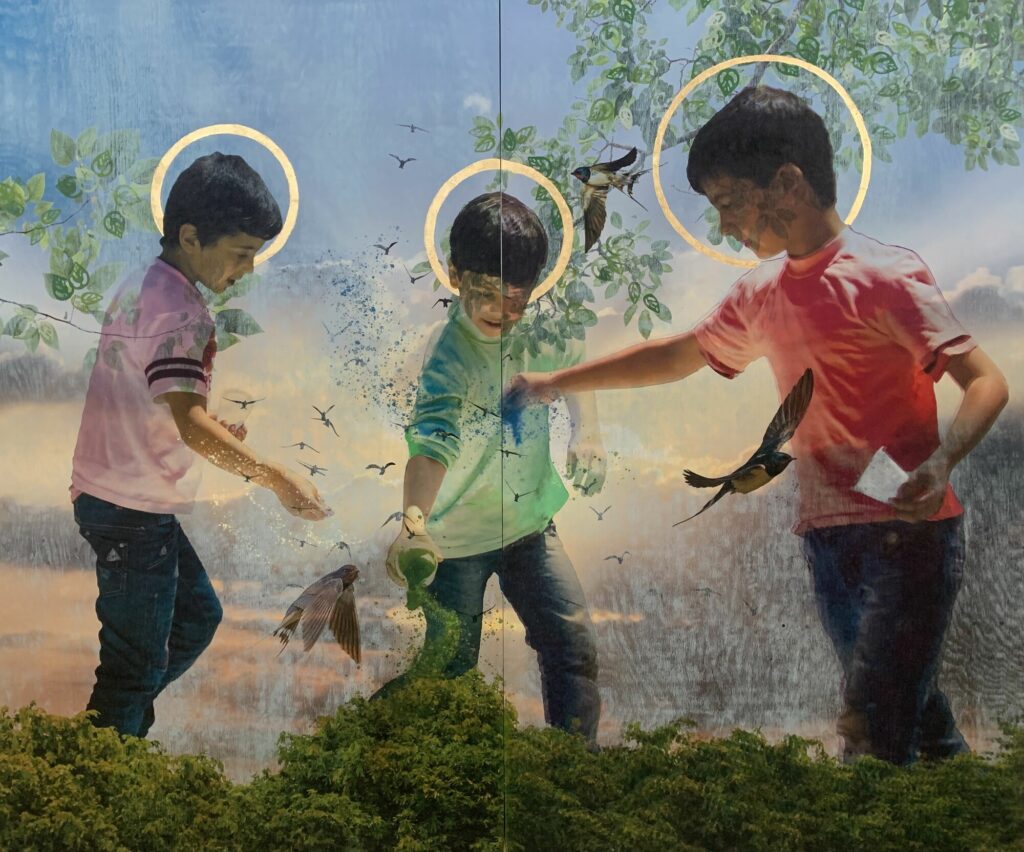
1: The salvific work of Creation.
‘God is the primary cause and end of all creation; He is that from which all beings flow and that to which they return. The being of all things is directed towards God as their end.’[9] The Principle and Foundation (§23) not only establishes the whole purpose of our lives ‘to praise, reverence and serve God our Lord’, but it also places us in a relationship with all created things that are created to help us attain our end.[10] The Principle and Foundation not only describes an ordering of the will in freedom but an ordering of the understanding in which all things are known in God, their creator and redeemer. This does not lessen their uniqueness and value but enhances it, for now they are known within the natural and graced relationships by which they are created, sustained and given life and the hope of glory.
At first, it may appear that we are being asked to have a rather instrumental approach to creation. The desire to make ourselves ‘indifferent’ to all created things and to ‘use’ them in so far as they help us to our end may support this reading. However, such a superficial reading would be a distortion. Even in the austere language of the Principle and Foundation, it is clear that creation is the gift of the Creator to us to help us to attain our salvation. Any instrumentalization of creationruns two dangers: either it dishonours the gift by making it work to our own purpose and not that for which God has created it, or we make it the source of our salvation, endowing it with a power that it cannot have. In both cases, we also exclude the capacity of creation for the Incarnation to which it is intrinsically ordered. We rob it of its glory by appropriating it to the service of our own will in a ‘perverse imitation of God’, as Augustine perceived.[11] When this is the case, creation itself is prevented from participation in salvation; it becomes subject to futility—a futility which we have imposed upon it (Rom. 8:20-22). Whether as instrument or idol, we distort creation and prevent it from attaining its own end, which is to bear witness to the Creator and Lord.
The Principle and Foundation reminds us that we too are ‘created’ and, therefore, part of creation itself. Indeed, in the wording of the Principle we can already hear an anticipation of our particular mission: not only to strive for our own salvation in Christ but also to work with him for the salvation of all created things. The ‘mission’ that is contained here turns on our freedom — our ‘indifference’. What is envisaged is a liberated desire for God that puts all our relations in their proper order. This is not the autonomy of the sovereign subject who owes nothing to anyone or anything but him or herself—a subject who stands over creation, whose fundamental relation is one of instrumentalization and utility. The freedom which the Principle and Foundation asks of the human subject is that of a service that is ultimately the ‘praise and reverence’ of the Divine Majesty, in which the human person realises the graced plenitude of their own existence.[12]The proper ‘use’ of created things is the grace that allows them to help us toward our end and allows them to achieve theirs. This ‘reciprocity’ is the hallmark of Ignatius; it requires first that we appreciate all created things, seeing in them(a) the life which God has given them, (b) the purpose for which God has made them, and (c) our redeemed (converted) relationship to them.[13]
This way of ‘seeing’ or understanding is a significant transformation that can be detected in the difference between the General Examen, which forms part of the 1st Week (§32 ff), and the Contemplatio ad Amorem.[14] The structure of the General Examen is traditional: we are asked to prepare for confession under the categories of thoughts, words, and deeds. Under words, we are asked to consider how we might offend God by swearing or blaspheming, for example (§38). Here, swearing by the creature or the Creator becomes a misuse of the former (idolatry) and a dishonouring of the latter. However, ‘those who are perfect’ can swear by the creature without causing any offence because they grasp that God is present in all things by ‘essence, power, and presence’ and as such, one is actually honouring the Creator in them. The threefold mode of God’s presence in creatures is a well-established position in medieval scholasticism.[15] What is interesting for us is the way in which Ignatius understands that reverence is due to the creature because of the Divine presence in it. For those who have a pure desire and love of God, then, the creature too is re-perceived and valued. Here, we are already looking forward to the fruits of the whole Spiritual Exercises in the Contemplatio (§230 ff. esp. 235). In the journey between the 1st Week. and the Contemplatio, we come to experience God’s salvific presence in all things. Creation can no longer be treated independently of God’s redeeming activity, of which it is a part, and the grace in which it shares. Now we can truly find God in all things (Buscar y hallar a Dios en todas las cosas) because we have come to find or know them in God. Creation has been restored to its own grace and not distorted into an idol as in pantheism.
Even within these preliminary considerations, the Exercises do not ask us to stand outside of creation; they profoundly relocate us within its ‘koinonia’. In so far as our relationship with God is healed to the ‘praise, reverence, and service’ of God alone, creation, too, is honoured, healed and served. It is loved in the right way, freed from our own exploitative rapaciousness, the depth of which becomes vividly apparent in the 1st Week, and which must surely have an ecological dimension, before we come to a ‘loving and reverential poise’ (acatamiento). This is not a disinterested neutrality but an attentive respect and care that liberates creation from our wounding distortions and misuses.[16] Although the Principle and Foundation is presented almost as a syllogism, within it is contained the whole existential drama of our dynamic freedom, our place before God and within creation. It is the drama of salvation itself in which we are enlisted. [17]Another important dimension which emerges from this is the active participation of our freedom in God’s salvific ‘labouring and working’ in creation and in history. Effectively, this is the capacity we have by virtue of our redeemed and converted freedom (to God) to bring good out of suffering. God gifts humanity with a unique freedom because it is only in this freedom that the person can love and return love and therefore realise the imago trinitatis which each one carries.The ground of this is our imitatio Christi, and it’s given in the 3rd mode of humility, the Contemplation of the Incarnation in the 2nd Week and the 3rd Week of the Exercises. In this way, the Exercises open up a new resource in the debates about gratuitous evil and the sovereignty of God in creation. Viewed from the Ignatian perspective, the problems presented for a ‘theodicy’ cannot be answered independently of the crucified and risen Christ and the immanent redeeming and sanctifying mission of the Holy Spirit who restores, renews and directs our freedom to participate in the mission of the Son.[18]
The two obvious texts of the Exercises in which these dimensions surface occur in the 1st Week (§60) and in the Contemplatio(§230), and, as we have seen, they are anticipated in the Principle. These two locations mark out for us the whole journey of our conversion into the service of Christ in his mission of our redemption and the establishment of the Kingdom. Both texts have a deep continuity, and they are quite remarkable for the place they give to creation and our role within it. As we explore these themes and how they unfold through the dynamics of the ‘weeks’, we will see their ever-deepening connections. Some repetition will be inevitable, but at each stage we shall see how in each movement important nuances arise.
Creation in the 1st Week—entangled in our sin but witness to the Divine mercy.
§60 invites us to the overwhelming, liberating encounter with God’s mercy that frees us from the captivity and debilitating illusions of sin, i.e. our various attempts to live in alienation from God and creation. The grace of this freedom, which is the gift of the crucified Christ, begins the healing of our will and understanding, which sin wounds and distorts. It is also our ‘exodus’ from our entanglement in the history that sin generates and our entry into the great pilgrimage of salvation history. This ‘new life’ or conversion is the profound experiential realisation that we cannot liberate ourselves. Indeed, whether through our actions, our cultivated ignorance or our complacent minimising of sin (personal and structural) and its effects, we become complicit in it. If sin has made us deaf and dumb, then before the crucified Christ we are given power to speak and proclaim the wonders of God’s mercy. The ‘surging cry of wonder’ before the crucified Christ bears witness to our recognition of what God has done and the grace we have received. Already, we discover that we are announcing the gospel of salvation. Already, grace frees us to begin to realise the purpose for which we have been created: to praise and extol God and to experience our creator and redeemer as one. It is not just the experience of a seminal moment; it is the initiation of a process that will continue throughout our whole lives. This is knowledge that will continue to unfold in us—an ever-deepening gratitude to God for the redeeming act of Christ’ssacrificial love ‘for me’.
This ‘for me’ (por me) is not the expression of egocentrism, but the in-breaking of a new understanding of the enormity of the work of God’s love and its cost beside my unworthiness and smallness.[19] This relational optic—reciprocity and comparison—is a central dynamic that runs throughout the Exercises. It schools us affectively in terms of our understanding and in terms of appreciating the immensity of the Divine Majesty—the luminous abyss of Divine Love revealed in the self-gift of the cross, the salvific fount of life—as well as in the astonished gratitude and humility that we should receive such an inestimable gift. The understanding that we have here has several dimensions: it is not only the humility of knowing we are created, but also the knowledge that we are redeemed sinners. This is no superficial or trite theological thesis. It is a graced knowing that is also experience; it is a ‘saving knowledge’ inscribed now in our very sense of self. Such knowledge is not accessible from any other source apart from grace.[20] It builds the habitus of gratitude into our whole way of being and acting, conscious that all is gift-grace. This is not only transformative for us, but it also reshapes all our relationships. When all is bathed in gratitude, then our actions change. We cannot manipulate or instrumentalise what we have received, whether it be people or nature; we can only give thanks and serve. We have begun to enter into the ‘koinonia’—the fellowship—of life, which is already the advent of the Kingdom. The scales fall from our eyes, we are being ‘renewed’ (Rom. 12.8); we begin to see anew what has always been there, the grace of God in the faithfulness of creation to its own gracious purpose: ‘I pass in review all creatures. How is it that they have permitted me to live and have sustained me in life’ (§60).
2: The mission of creation.
At this point, we can begin to appreciate what is unique in the Ignatian understanding of creation. It will certainly share dimensions of the sacredness and sacramentality of creation with other schools of Christian and religious thought. It will also prove itself adaptable to a modern appreciation of the complex, interrelated and relational dynamics of the biosphere. However, the Ignatian perspective will recognise the soteriological work of creation and its participation in God’s salvific purpose—creation also has its mission. What unfolds between §60 of the 1st Week. and the Contemplatio is the ‘integral ecology’ of the economy of grace in which the life-giving communion of all this is redeemed. For Ignatius, this is never a static reality but the way in which the whole communio of creation, angels and saints participate in the work of preservation, salvation and sanctification. It is as if we can ‘see into the heart of things’ and find that not only is God active in all things, but all things have their ‘mission’— they, too, are working and labouring ‘for me’.
The litany of the verbs is instructive, they constitute the ways in which creation is founded on God’s providential care and covenantal purpose even for those who would destroy it and refuse its communion: ‘they have permitted me to live, havesustained me in life; tolerated me, guarded me, and prayed for me, interceded for me and asked favours for me’.[21] In this intense and compressed paragraph, we have Ignatius’ Franciscan canticle, but it is not just the way in which all creatures praise their Creator for the gift of their being, it is also the way in which, in being, they perform their mission of manifesting and making real God’s saving ‘hesed’ or loving kindness. In this sense, creation is a genuine home for us who have made ourselves prodigals. At some level, we may now begin to see how creation itself has always been ordered to the Incarnation. Although we can only grasp it proleptically from the full event of the Incarnation (the totality of Christ’s life, death, resurrection), we see that creation is ordered to the Incarnation and comes to its own fullness in it. It, too, lives now in the hope of the resurrection: life beyond the limit and threat of death and extinction. Indeed, in its very ‘givenness’—as gift and as ‘being there’—the communio of creation manifests and mediates the lordship or sovereignty of God’s faithful love—‘eternal Lord of all things (§98)—and in this it remains a source of possibility and hope. What Ignatius captures in these two major exercises is the grace of creation’s fidelity to us and to its mission. This is why creation, covenant, incarnation and resurrection have an inner unity as the hymn of I Colossians recognises and the whole ‘cosmic Christology’ of Maximus the Confessor explores. It also bars the way to a naive nature romanticism or to pantheism, for the very ‘givenness’ of creation refuses to be made an end in itself. As the Ignatian mediation sees so clearly, it is in its very character as ‘gift’ that creation discloses its being—its fidelity, its ‘being thereness’ or ‘givenness’—and therefore creation always transcends itself. We mistake this ‘givenness’ if we simply take its availability and permanence for granted. When we do this, we devalue and misuse it.
3: Discerning freedom in creation.
If science teaches us that our world is governed by certain laws, that does not mean that the whole ‘communio’ of the created order is determined. We constantly see multiple forms of adaptation at play; we recognise that such change is not always a ‘blind’ response but can reasonably be recognised as some form of learning. We also see that certainly among primates there is the capacity for choice, and, even in the most basic and simple sense, this must imply some measure of ‘freedom’. While humans stand firmly within the laws and processes that determine the material and natural world, they display a unique capacity for choice predicated upon a radical freedom that allows humans to be conscious and intentional agents. All our social and cultural systems and products are predicated upon the capacity for freedom. This is especially true of the moral order. The Judaeo-Christian traditions, while recognising that the human person always operates within the conditions of the natural order, resist an absolute determinism that would rob the human person of their freedom and responsibility. The concepts of fate and destiny have no place before God, who is radically undetermined by anything other than the divine nature. The Divine act of creation itself takes place in this freedom, which it also carries. Equally, if our chief end is to love and serve God (as the Principle and Foundation asserts), then love can only be realised in freedom. If God creates us in love for love, then God must also create the human subject to be free.[22]
Coming to terms with the history of sin and our part in it is to develop a new understanding of who we are before God and within creation. If we do not have this, we will not appreciate the salvific mission of creation itself. We will also fail to see that we now have new reciprocity to express our own mission of care and gratitude so that the whole community of creation can participate in Christ’s salvific mission to God’s glory (2 Cor. 3 ff.). If the whole community of creation (natural and sanctified) is working for me, then I enter into this community by sharing in its work, for ‘love ought to manifest itself in deeds rather than in words’ (§230). For Ignatius we are called to be actors, which means that we are endowed with the freedom to choose as well as the imagination and intellect to make our choices effective. In this respect, we are also creative agents within creation. It is part of our unique power to understand creation and to help to shape its future for good or for bad. If we have understood our place in creation well, then our ‘care’ of creation is also a soteriological act: it is to respect the status of creation as God’s gift and co-operate in its mission. The Ignatian vision does not commit us to determinism but rather places upon us a spiritual and moral responsibility to use creation well. This goes beyond a simple anthropocentrism that prioritises the human good over all other goods. The grace of conversion, which relocates us within the ‘koinonia’ of creation, requires us to seek the good of all things. It entails the recognition that the whole of creation is called to redemption, and its flourishing, in all its dimensions and relations, is for God’s greater glory. Here we encounter the eschatological or salvific good of all things. Insofar as the redeemed person is restored to the communion of creation, then his or her choices are made within this eschatological horizon. As the Exercises understands God to be ‘labouring and working’ in creation for its lasting good, so must we labour and work for it as well. Our conversion to the world is also our vocation to serve and seek its healing and sanctification. The danger of a naive understanding that creation is somehow innocent must be avoided. We need to recognise that creation itself is still in action; it carries extraordinary and indiscriminate violence and destruction that seem to be built into ‘natural forces’. Gratuitous acts of violence—those which are not ‘adaptive’—have also been observed in the higher primates. Even though it would be a mistake to impose human moral systems and judgements upon such acts, nevertheless, they should alert us to the systems of disordered relations that are deeply and unaccountably embedded in our universe. A mature eco-theology must take this into account.[23]
From the Ignatian perspective, the gift of a healed and restored freedom is about the realisation of ‘the self’, but through the loving service of God, neighbour, and the gift of creation. Freedom cannot be exercised in a vacuum; it is inherently relational, and there is no way to the self which is not through relationship to and with the ‘other’. For the Spiritual Exercises the ultimate ‘other’ is the Triune God who is the ground of all created relations. Our contemporary culture’s obsession with ‘freedom’ is also an obsession with the power to impose our will and declare self-determination. This turns the exercise of freedom into a type of tyranny that ultimately destroys the very relationships that it needs to realise itself.Hence, the grace of conversion is not only the restoration of those relations destroyed or damaged by sin, but also the restoration of our very capacity for relationality, which is essential to our identity.
Through the Exercises, we come to see that we do not make ourselves; we receive ourselves in and through our call and mission.[24] This experienced ‘truth’ is central to discernment: the exercise of our freedom in choosing what best serves Christ’s mission of salvific love. Although we are called to use all created things, this is far from a license to impose our unrestricted desire of the self, accountable only to itself and its own needs. The ‘use’ must always attend to what serves the good of all created things. The good of each exists only in the communion of the good that includes all. Even when goods may prove to be incompatible, the good of the other cannot be dismissed. Our agency is tested by the measure in which we are free to put the good of the other first.[25]
Freedom, which has love as its end, will always entail responsibility for the other, and that will have a temporal dimension. Not only does it encompass the present, but it also makes provision for the future. Insofar as discernment is an exercise of our freedom and judgement, it will possess an eschatological orientation in hope and faith, i.e. the certainty of Christ’s promise fulfilled.[26] In fact, Christian freedom will always be exercised within this eschatological horizon, for it knows that it must ultimately be accountable not just to the present, but to past and future generations as well and ultimately to God.[27] For this very reason, true freedom is realised in the capacity to change, to repent and to learn. It is one of the greatest challenges to our freedom and the source of our hope that God has endowed all creation with the capacity to adapt and to change, not only in order to repair what has been lost but also to continue the grace of living and flourishing deeply in the knowledge of God as Creator and Lord. In this dynamic, we must locate the gift of freedom which God bestows on human beings, giving them a unique agency and spiritual intelligence.[28]
The exercise of this redeemed freedom, therefore, will seek to be a choice for the good of the whole community of creation and against the destruction or the degradation of that good. This does not mean, however, that we should not act to change what is injurious to life and flourishing. On the contrary, this, too, is part of our responsibility to the continuous work of creation. In all these ways, discerning freedom will have the character of being a ‘consoling’ freedom. Its choices and actions will bring consolation—life, creativity and restoration of the good—for it participates in the work or mission of the Risen Christ (§224). When all things working together according to their uniqueness-in-relation manifest their creativity and the plenitude of life, it is to God’s glory, reverence, praise and delight.
A fuller treatment of the Exercises’ understanding of the presence and mission of creation and humanity’s role in it would require us to attend to the body in prayer, which is also invited to ‘labour and work.’ For Ignatius, the spiritual as well as corporeal senses enable us to know and, in some experiential sense, to participate in the bodily reality of the crucified and risen Christ. The presupposition of our desire to attune our body with that of Christ’s, itself the action of a graced love, is incarnation and the perichoresis of the two natures so that we enter into the full mystery of Christ’s person.
We cannot enter the reality of the Contemplatio without the experience of the preceding Weeks, which draw us ever more deeply and personally into the way God’s ‘labours and works our redemption’. The intense Christological orientation of the Exercises, in which we are brought so intimately into the mystery of Christ’s humanity and divinity, must banish any hint of Manicheanism. Not only does this shape our understanding of the material and spiritual creation, but it also encompasses the human work of creation that comes forth from it. The whole of the creation and, indeed, the ‘world’ that we humans make is not alien to God. It is the theatre of God’s glory which shines forth not only on Tabor or Easter morning but out of the darkness of the cross. Even when, as the Divine glory shows, it is a world with its own contradictions, it never loses its blessing and goodness. In the power of the grace of Christ and His Spirit, it is still God’s work in fieri to its perfection. If it is the theatre of grace and encounter, where this strange yet familiar God is met in Majesty and hiddenness, it is also the theatre of our freedom and responsibility, the world of our hope and the court of our judgement. Notwithstanding the brevity of this sketch, we can see how Ignatius’ understanding of creation is dynamic, open, and concrete, yet everywhere filled with God’s saving grace and presence with Christ at its centre. In the Ignatian imagination, it is a theocentric world which opens up a new understanding of humanity’s place and the vocation of each individual within its communio. The healed and restored freedom that we discover in the Exercises is central to fulfilling our mission to bring ourselves and the whole of creation to ‘praise, reverence, and to serve God our Lord’.
Recovering Week 4.
Given the relative brevity of the 4th Week in the Spiritual Exercises and its concluding position, there has been a tendency both in practice and in commentary to underplay its weight and significance. The whole possibility of Christian life and faith hangs on the resurrection of Christ. It is the presupposition and possibility of all the Weeks that precede it. The 4th Week, with its important transformational encounter with the Risen Christ, is critical for the mission which the exercitant receives.[29] In the same way, there can be no entering into the Contemplatio that does not pass through the 4th Week.[30] The habitual dispositions of the Contemplatio flow from the gratitude and the restored freedom to love grounded in the election to companionship which we now have with the Risen Christ—a Christ who is always encountered in mission under the power of the Holy Spirit. In key exercises we have been prepared for this encounter: the eyes of our understanding have been purified each of the preceding weeks, and our senses have been attuned to recognising the Lord.
The resurrection is disorienting for our experience and understanding. Not only is it a liminal experience for the first witnesses but it also continues to be liminal for all Christians. The resurrection of Christ is of a totally different order from that of Lazarus. The risen Christ still retains his bodily integrity, but it is clearly no longer subject to decay or death. The world we now live in and thought we knew is utterly changed while remaining strangely familiar. The resurrection of Christ does not abolish matter, time, space and their properties, but it is not bound by them in the way we thought it was. In the areopagus of the secular scientific world that puts a premium on its own version of rationality, laughter should not be a surprise. The closest analogy that we might have is the way in which Newtonian physics, relativity and quantum all describe our world and operate within it, but not in the same way or at the same level. It is one of the significant features of many ‘theologies of creation’ that they start from the presuppositions of a secular world rather than the resurrection of Christ. Yet given its implications for our understanding of the ‘laws’ of our world, the resurrection cannot be an unnecessary appendix to the Christian doctrine of creation.[31] To this extent, it presents us with new epistemological, ontological and ethical realities.
In his Gifford Lectures, N.T. Wright seeks to reframe ‘natural theology’ from within the resurrection’s reshaping of our understanding between God and the world, ‘Jesus’ resurrection, by unveiling the creator’s healing and transformative love for the whole of creation, opens up space and time for a new holistic mode of knowing, which includes historical knowledge of the real world framing it within the loving gratitude which answers the creator’s sovereign love’.[32]Wright argues that the resurrection takes us into an ‘epistemology of love’, which is a fuller way of knowing the epistemologies that our cultures have been accustomed to assuming and operating within.[33] Wright argues that an ‘epistemology’ that is initiated in the resurrection is a graced knowing, a knowing from within God’s knowing. This way of knowing is an active loving, hence the epistemology of love is ‘a whole person activity’, it is a relational action which entails the community; it has a spiritual dimension. It is not so much concerned with mastery and the Nietzschean will to power as a redemption of power itself transposed to gratitude and service—it is concerned with the seeking of the good of the other. [34] Wright’s insights into the transformative grace of the resurrection could well stand as an analysis of the Contemplatio, especially as he brings out the vocational dimensions which it entails, ‘In this sort of knowing one is fully involved with the drama of the reality which is known, in this case the person of the crucified Jesus himself. It involves humility, recognising that all knowing involves us small short-sighted creatures engaging with a wide and complicated world, and gratitude, recognising that the resurrection is above all the genuine foretaste of that new creation which, like the original creation only so much more, the fruits of the Creator’s self-giving love. Instead of trying to grasp it or master it, we are grateful for it, and turn that loving gratitude into vocation, the image-bearing vocation once more’.[35]
In his treatment of the resurrected Christ, Aquinas also attends to this new reality and its epistemology. However, for St Thomas, in a way which is perfectly consonant with the 4th Week of Spiritual Exercises, integral to this new knowledge is that it is always a disclosure of God’s redemptive mercy. We can see this most clearly in his treatment of the wounds of the risen Christ. The risen Christ is recognisable by his wounds; they are proof not only of his bodily identity but his identity as redeemer. History is neither erased nor is suffering easily confined to the past. As Aquinas argues, the wounds of Christ are efficacious for us and now mark his mission of intercession before the Father. No longer the marks of shame and degradation, the ‘ikons’ of subjection or the ultimate power of worldly kingdoms, they now become the ‘ikons’ of God’s glory.[36] From the experience of the 4th Week the reality of the risen Christ and the healing grace that he bestowsis confirmed. We do not leave it behind but from it step into a world with this new understanding and agency. Whatever the final ‘election’ the exercitant has made, no one leaves the 4th Week without being an apostle of the Risen Lord, empowered for mission.
We cannot enter into the 4th Week or appropriate Christ the consoler if we do not also appropriate the gift of the Holy Spirit, the unsurpassable witness of Christ’s resurrection and exaltation, and whose life indwells in us.[37] We come to recognise that the ‘shalom’ of the risen Christ is the ‘shalom’ of his kingdom now present, active and secured within human and cosmic time. In his gift of peace, the risen Christ pronounces the eschatological blessing for the whole of creation. The ‘shalom’ is reordering our relations to all created things and it constitutes the mission, ethical and spiritual, that we now must restore and cherish God’s first gift. In the event of the risen Christ, creation itself is liberated and called into glory.[38] The relationship between creature and Creator is not changed but realised in all its dimensions. The finitude of created things is no longer determined by the horizon of death and decay but by the creative plenitude of new life whose ontology is now the inexhaustible cruciform love of God’s own Triune life. In the bodily resurrection of Christ, matter is redeemed, confirmed and sanctified. We come to understand that we cannot be redeemed without it. Creation is our home—not our place of exile. [39]
Unity of the 4thWeek and Contemplatio.[40]
Previously we explored the way in which the Exercises opens up the nature of God’s presence in creation from a principle of scholastic metaphysics to the soteriology of an immanent, personal salvific Love. However, it is important to recognise that we cannot arrive properly at the Contemplatio without the journey and the processes of conversion that have been active in the preceding weeks. In this sense, the Contemplatio is the consolidation of the liminality of the grace of the Risen Christ salvifically active in all created things. As such, it becomes our habitual way of encountering God, and, to this extent, it is an experiential eschatology.[41] The Contemplatio refuses to allow us the false consolation of an ecological romanticism. When we are invited to ‘consider how God works and labours for me in all creatures upon the face of the earth’, we are located in the active ‘memory’ of the cross. Given the preceding Weeks, we cannot now understand this ‘labouring and working’ purely in terms of God’s act of continuing creation. It is God’s continuing work of redemption of which we are made agents as companions and apostles of Christ; we are called into the particular Ignatian form of the imitatio Christi flowing from our own experience of the depths of the Divine mercy (Eph. 2.4-5).
Just as we recognise the risen Christ by his wounds, so we now see that the cross is integral to the whole of creation.[42] The great eschatological hymn at the beginning of Colossians has become ours. Creation is secured within the new time of the Kingdom, although like us and with us, it must continue until the Parousia. We can now begin to hear that creation, too, has its own Magnificat in which we are called to participate (Rom. 8.18-23).
Conclusion ‘Seeing all things new’[43]
‘Conversion’ is at the heart of the Exercises. It is translated into the election and the processes of discernment that continue to shape our life and actions. Conversion is also at the centre of the encyclical Laudato Si. Transformation of systems, structures and practices is urgently needed to create and sustain an integral ecology. This requires a new epistemology and relational ontology.
A principal thesis of this essay is that the Spiritual Exercises can be an effective source of this epistemological, ethical and ontological conversion. The Contemplatio locates us in a sacramental vision of reality, the communio of a redeemed creation, of which we are now called to be the priest-servants.[44] It confirms and empowers us in our vocation to be the ministers of Christ’s grace to all created things. And as ‘love manifests itself more in deeds than in words’, it requires us to establish those concrete love-governed ethical structures that protect creation and support its flourishing. It will stand in the Christ-Spirit truth in which it now participates and resists all the self-interested, self-absolving denials of the ecological crisis. It will move us to adopt lifestyles and attitudes that better cherish the gift of the other. It will entail a new asceticism which refuses exploitation and instrumentalization, and recognises that nature has rights—a way of enshrining the good of the other, which is more than pragmatic protectionism.[45] Restored and available to us through the Resurrection of Christ, the wonder and the gratitude that creation elicits in us now becomes our self-gift, the act in which love is realised in responsibility and service which de-centre the self; it is an imitatio Christi.[46] The ‘suscipe’ (§234) is not only an offering which flows from the Spirit-filled heart overflowing in love, but it also expresses our ontological freedom and security for which the whole of creation longs, no longer usque ad mortem, but now already drawing from the gift of eternal life. Here, too, we hear echoes of St Francis. The complete self-offering is the point at which ‘poverty’ becomes the condition of our being, not as lack or threat, but as grace. Loving God makes us wonderfully poor, for, by possessing Him, we no longer need to possess anything. This is the poverty to which the creature comes with complete trust and thanksgiving before the Creator, as the Son before the Father. In the self-giving kenosis of our being, our time and history, ‘all that we have and possess’, we enter into an absolute dependency that surrenders to God’s sovereignty in love. It flows from the new epistemology and relationality of our converted existence and the recognition of the destructiveness of our current economic and technological systems that subjugate human as well as natural life to a logic that privileges certain classes and cultures.[47] In a new and vibrant way, spiritually as well as ethically, the culmination of the Exercises in the Contemplatioconfirms the universal destination of goods, ‘the first principle of the ethical and social order’.[48] It dilates our lives in gratitude that seeks expression in self-giving service; it opens us to experience the constant creative kenosis/Suscipe of the Holy Spirit, the Lord and giver of life, that marks presence of the Kingdom of God, and incorporates us into the chorus of life in praise of ‘our creator and Lord’, ‘for the Spirit of the Lord fills the whole earth’ (Wis. 1:7).
James Hanvey SJ
[1] For reports and updates, see UNCC, https://unfccc.int.
[2] LeVasseur, Todd, and Anna Lisa Peterson, eds. Religion and Ecological Crisis: The ‘Lynn White Thesis’ at Fifty. London: Routledge, 2016.White’s influential essay (originally 1967) is contained in this collection with contemporary discussion and a wide range of essays. For a critique from the Islamic tradition, see also, Nasr, Seyyed Hossein. Man and Nature: The Spiritual Crisis of Modern Man. London: Unwin Paperbacks, 1990; ‘Seyyed Hossein Nasr’s Works on Environmental Issues: A Survey’. Islamic Studies 58.3 (2019); Nellist, Christina, ed. Climate Crisis and Sustainable Creaturely Care: Integrated Theology, Governance and Justice. Newcastle-upon-Tyne, England: Cambridge Scholars Publishing, 2021.
[3] Jonas, Hans, and Robert Habeck. Das Prinzip Verantwortung: Versuch einer Ethik für die technologische Zivilisation. Berlin: Suhrkamp Verlag, 2020. See also, Morris, Theresa. Hans Jonas’s Ethic of Responsibility: from Ontology to Ecology. Albany: State University of New York Press, 2013; Andriamparany, Tiana Rado Charles. Hans Jonas et L’écologie: Vulnérabilité et Responsabilité. Paris: Editions L’Harmattan, 2022; de Oliveira, Jelson R., and Grégori de Souza. ‘Integral Ecology as a Call to Responsibility: Approximations Between Hans Jonas and Pope Francis’. Religions (Basel, Switzerland) 16.5 (2025): 602; Jenkins, Willis. The Future of Ethics: Sustainability, Social Justice, and Religious Creativity. Washington, D. C: Georgetown University Press, 2013; Jenkins, Willis. Ecologies of Grace: Environmental Ethics and Christian Theology. Oxford: Oxford University Press, 2013. Jenkins, Willis. ‘Contemplative Life amidst Mass Extinction: Catholic Revisions of Spirituality, Law, and Multispecies Justice’. Journal of Contemplative Studies 3 (2025): 1-25; Jenkins, Willis. ‘The Mysterious Silence Of Mother Earth In “Laudato Si”’. The Journal of Religious Ethics 46.3 (2018): 441-462.
[4] President Trump’s speech to UN, 23rd September 2025. https://www.rev.com/transcripts/trump-speaks-at-un. For a radically different position, see Francis, Pope. Praise Be to You – Laudato Si: On Care for Our Common Home. Vatican, Rome, 2015, hereafter LS. Pope Francis regards Laudato Si as a social encyclical and correctly argues that ecological concerns cannot be separated from economic, political and social systems that often lie at the root of the ecological crisis, which in turn generates a crisis in the other fields. Important stimulus and background to LS is ‘Aparecida’, the document issued by the Episcopal Conference of Latin America and the Caribbean, (13-31 de mayo, 2007), chaired by Cardinal Bergoglio before he became Pope.
[5] In the ‘Autobiography’, Ignatius records how creation, especially the stars and night skies, is a source of joy and consolation for him. Auto. §11; 29.
[6] Ignatius’ understanding of God as ‘Creator and Lord’ ‘y redemptor’ (Sp. Exx.§229), and its linguistic-theological field (see entries in Concordancia Ignaciana) are rooted in his personal experience. In the Autobiography, he speaks of it being revealed to his understanding how God created the world (Auto. §29). It is also reinforced in the illumination of the Cardoner in which he sees ‘all things new’ (Auto §30). It is part of the Principle and Foundation and runs throughout the Exercises. It has special importance in the preamble to the election (Exx. §169) and is the source from which we draw both the wisdom and the strength to resist the enemy (§324) (for example, Cons. §272). See also, Salles, Walter F. ‘A Hermeneutics of Ignatian Mystique: Creation in Christ’. Perspectiva Teológica, 52.2 (2020): 461-473.
[7] This identity in the cross is a central theme that also marks ‘inner architecture’ of creation itself in the thought of Ireneus and the Cappadocians, especially Gregory of Nyssa. It has its fullest development in the theology of Maximus the Confessor and is prominent in the theologies of Jurgen Moltmann and Hans Urs Von Balthasar. See, Blowers, Paul M. Maximus the Confessor: Jesus Christ and the Transfiguration of the World. Oxford: Oxford University Press, 2018, esp. 230 ff.
[8] The unity is given in creed grounded in scripture (Eph.1.3-14; Col.15-20). See also Lubac, Henri de, and Richard Arnandez. The Christian Faith: An Essay on the Structure of the Apostles’ Creed. San Francisco, CA: Ignatius Press, 1986. For the theological significance see Wood, Jordan Daniel. The Whole Mystery of Christ: Creation as Incarnation in Maximus Confessor. Notre Dame, Indiana: University of Notre Dame Press, 2022. This becomes important when understanding the Contemplatio in the discussion below.
[9] Kerr, Gaven. Aquinas and the Metaphysics of Creation. New York: Oxford University Press, 2019, p 222.
[10] Although the Spiritual Exercises arise out of the experience of Ignatius at Manresa and his subsequent prayer and reflection, in their final form they are also shaped by his study and understanding of theology. In addition, Ignatius and the early Society were concerned to maintain the orthodoxy of the Exercises given the many criticisms and questions that they received, not least of which was Ignatius own encounters with the Inquisition. Behind the statement of the Principle and Foundation and the understanding of creation and humanity’s place in it stands the theology of Aquinas see Ganss’ introduction to the Constitutions p.10 for a more detailed and technical discussion of Aquinas’ teaching on creation see Kerr, Gaven. Aquinas and the Metaphysics of Creation. New York: Oxford University Press, 2019, especially chapter 7 The End of Creation which could also be a commentary on the Principle and Foundation.
[11] Cf. Enn. In Ps. LXX.ii.6. In the argument ‘amor sui usque ad contemptum Dei’, of the De Civitate, Augustine analyses the dynamic of our pride and its consequences in alienating us from God (and also from the good of creation). Ignatius also maps a similar dynamic in the Two Standards, Sp.Ex. §142. The same argument is developed by Benedict XVI and in Norman Wirzba’s, The Paradise of God: Renewing Religion in an Ecological Age. Oxford: Oxford UP, 2003. Cf. discussion below.
[12] The freedom signalled in the Principle and Foundation is the freedom directed to and lived in the 3rd mode of humility. It has, therefore, an implicit Christological form grounded in the salvific kenosis of Word in the trinitarian life that becomes the basis of mission ad extra and is contemplated in the Incarnation Sp. Exx. 102 ff. The examples of freedom noted in the Principle and Foundation—health v. sickness, riches, v.poverty, honour v. dishonour, a long-life v. a short life—are all expressions of our lived creatureliness, so that our own status as created isexpressed in a freedom to be totally available to God. See, Dhôtel, Jean-Claude. Les Exercises: Le Text et L’expérience du Fondement. CIS Italia (1982), pp. 88-104.
[13] It is important to recognise that the ‘reciprocity’ that is sought in the Exx. is itself a grace. God does not compel or demand it; it is grace itself that heals our freedom such that our response to God, our self-gift in the light of God’s own self-gift (in creation and redemption), is our own free act. It arises from and flows from gratitude, itself the recognition of love received and an act of returning love. It has both epistemic and affective dimensions.
[14] Sp. Exx §24-44. The Examen in its various forms is an important foundational practice not only for the time of the Exercises but also for progress throughout one’s life.
[15] Cf. also Aquinas, ST.1.1.8: ‘Therefore, God is in all things by His power, inasmuch as all things are subject to His power; He is by His presence in all things, as all things are bare and open to His eyes; He is in all things by His essence, inasmuch as He is present to all as the cause of their being.’ This formulation is also designed to counter various positions which either diminish creation (Manicheanism) or God (limiting God’s providence or omnipotence).
[16] The ‘acatamiento’ or ‘reverencia y acatamiento’ that occurs here (§39) is an important word for Ignatius. It not only indicates a certain reverential disposition and disponability before the Divine Majesty, but it also carries a sense of freedom (affective)—acatamiento amoroso (Diary §187)—and readiness to serve (cf. its repeated use in the Spiritual Diary). My suggestion here is that it also extends to the way in which we are open to creation (cf. also Sp.Ex. §39,75, 114). It can also take the form of a reverential humility and ‘fear’, acatamiento temeroso, especially when Ignatius is seeking to know his own failings (Diary, 187). It describes a graced experience of our relationship with God and complete disponability to God’s will. See Spiritual Diary, especially entries 3rd March ff. Also, Diccionario Acatamiento-Reverencia, pp. 77-79. As it also extends to creatures see, Gonzalez, M. La Espiritualidad Ignaciana. CIS, Rome (1986), p. 17. Also, Martínez-Gayol Fernández, N. C. Gloria de Dios en Ignacio de Loyola. Santander: Sal Terrae Mensajero, 2005, esp. 93-111.
[17] Ignatius reflects Augustine’s framing of our existential drama with creation—the movement between our freedom and judgement to use (uti) and to enjoy or rest (frui), Augustine’s point being that we can only truly rest and come to fullness of enjoyment in God.
[18] It is not possible here to enter more fully into this complex but important discussion for the theology of Creation. Suffice it to alert us to the possibilities, theological and practical, that the Exercises offer especially in highlighting the responsibilities of Christian freedom to all of God’s creation. Useful for opening up the current discussion, see Little, Bruce A. A Creation-Order Theodicy: God and Gratuitous Evil. Lanham, Md: University Press of America, 2005; Peterson, Michael L. God and Evil: An Introduction to the Issues. London: Routledge, 2018; Blocher, Henri. Evil and the Cross: An Analytical Look at the Problem of Pain. Grand Rapids, Michigan: Kregel, 2004. Peters, Ted. ‘Evolution, Suffering, and Eschatological Redemption: Sollereder, Southgate, and Russell on Theodicy’. Theology and Science, 17.2 (2019): 195-208. For the profound penetration of the cross in creation that can sometimes be absent in the treatment of the question, see Maximus the Confessor, op.cit. above, and Balthasar, Hans Urs von, and Graham Harrison. Theo-Drama: Theological Dramatic Theory. Vol. 3, The Dramatis Personae. The Person in Christ. San Francisco, CA: Ignatius Press, 1992. Esp. Christ’s mediatorship in Creation. In Vol. 4, see esp. ‘Guilt and the World’s Suffering’ and the full treatment in Part III, ‘Acting from within God’s Pathos’. See also references in fn. 17 below.
[19] Sp. Exx. 59.
[20] It is important to attend to the ‘deep grammar’ of these exercises. They are grounded in the mystery of the incarnation as a salvific act thatboth exposes the true nature of my sin and also the healing nature of God’s gracious love. Ignatius does not separate them. To do so would continue the distortion that sin itself brings either by making our sin and guilt so great that they are beyond God’s mercy, thereby denying God’s omnipotence, or by only seeing the immensity of Divine love and using it to obscure or hide the gravity of the sin that is committed. Paradoxically, this diminishes our understanding of the nature and depth of the Divine Love. Sp. Exx. 53; 58, 59.
[21] It is useful to notice here that the transposition from being in exile (‘cast out to live among brute beasts’ [§47]) and a source of corruption to being restored to the communio of creation that has preserved one’s life.
[22] Karl Barth makes this freedom part of the definition of God who reveals God’s self: ‘God is the one who loves in freedom.’ This constitutive act of the Divine sovereignty is realised not only in the act of creation ‘ex nihilo’ but in the incarnation which is completed in Christ’s suffering, death, resurrection and exaltation. Barth, Karl. Kirchliche Dogmatik. Ed. by Thomas F. Torrance. Trans. by G. W. Bromiley. Massachusetts: Henderickson Publishers, 2010. II.I §28-30.
[23] It is not possible within the limits of this paper to do so, but it could fall within a deeper ecological dimension of the 1st week and the radical and profound transcendal nature of sin that is entailed there. However, as §60 also indicates, the primary experience is of the continuing graciousness of the created order in the face of human alienation and disorder. See, Sandel, Aaron A, and David P. Watts. ‘Lethal Coalitionary Aggression Associated with a Community Fission in Chimpanzees (Pan Troglodytes) at Ngogo, Kibale National Park, Uganda’. International Journal of Primatology, 42.1 (2021): 26-48. See also, Goodall, Jane. The Chimpanzees of Gombe: Patterns of Behavior. Cambridge, Mass: Belknap Press of Harvard University Press, 1986. For theological discussions, see Luy, David, Matthew Levering, and George Kalantzis. Evil and Creation: Historical and Constructive Essays in Christian Dogmatics. Ashland: Lexham Press, 2020; also, Macdonald, Paul A. ‘God, Evil, and the Good Creation.’ God, Evil, and Redeeming Good. Vol. 1. London: Routledge, 2023, 59-98. Johnson, Connie, and Robert Falconer. ‘Creation Order Theodicy: The Argument for the Coexistence of Gratuitous Evil and the Sovereignty of God.’ CONSPECTUS, 27.1 (2019): 50-70. This opens the question of ‘evil’ and creation, especially God’s good creation. It is clear from the Exx. 45. That Ignatius sees all the orders of creation (spiritual and material as well as human) as entangled in the mystery of sin. Equally, any attempt to grasp the depth of this question cannot be separated from the Logos/Son as the ground of creation and the goodness in which being itself is constituted and participates. For this reason, there is no separation between Creator and Redeemer; redemption is bringing the whole of creation to its ultimate purpose.
[24] The action of a graced process that begins with our conversion, but it is also a Christological principal as it presents the dynamic of Christ’s person who, in the incarnation, reveals himself in the mission he receives from the Father in the Holy Spirit who bears witness to his sonship.
[25] The Love of Neighbour which is made concrete in our service of others. This principle is written into the Constitutions §547; 250. It is enshrined in the practice of ‘cura personalis’. However, the judgement of the good of the other is also an act of discernment which must also attend to its temporal character. It must not only only consider he immediate good but the long term and ultimate good.
[26] Cf. §95 the promise of Christ, which is secured in Week 4. The resurrection is more extensively discussed below.
[27] This is the other dimension of communio that we experience in the living community of the Church, but it is also present in the communio of §60. We should also note that the participation in the Divine life of the angels and the saints points to the way in which ‘past’ generations become also the future—they ‘go before us’— thus the temporal order discloses its eschatological one.
[28] This does not mean that other life-forms do not possess their own ‘intelligence’, which expresses itself not only in adaptation but also in and through complex relations with their species and environment. Any treatment of the biosphere must liberate itself from the prejudices of its anthropocentrism if it is to appreciate the multiple forms in which all life exhibits what we might call ‘intelligence’ and different modalities of responses to the world.
[29] Although the 1st Contemplation is proposed as the template followed by various notes §218-229, the brevity is deceptive. All the appearances of the resurrected Christ, including those to Paul, as well as the Ascension, come to some 14 Contemplations in all. However, the emphasis remains the same in each: the interior grace of the joy that comes from the presence and glory of the risen Lord and a deeper apprehension of the mystery from the way in which the Divinity hid itself (3rd Wk.) to how it now reveals itself in the risen Christ. In other words, in the Contemplation of the risen Christ, we come to see him in the fullness of his divinity and humanity. In the completeness of the knowledge, we not only experience the power and depth of Christ as our consoler, but we are now also constituted witnesses and consolers.
[30] Without the 3rd and 4th Weeks there is considerable risk of misunderstanding the Contemplatio or turning into some panentheistic quasi-mystical exercise missing or diminishing the dynamic redeeming engagement with world which it contains.
[31] For a more extended treatment of the resurrection as integral to creation, see Hanvey, James. ‘Laudato Si’ and the Renewal of Theologies of Creation.’ Heythrop Journal, 59.6 (2018): 1022-1035. Also, Lorenzen, Thorwald. Resurrection and Discipleship: Interpretive Models, Biblical Reflections, Theological Consequences. Maryknoll, N.Y: Orbis Books, 1995, esp. chapter 12.
[32] N. T. Wright, pp. 205 ff. Also Lorenzen, op.cit. chpt. 9, ‘The Dialectic of Christian Knowing’.
[33] Ibid. 208.
[34] Ibid. 210-212.
[35] Ibid p. 211. See also the signs of ecological conversion outlined in LS § 220-21: gratitude, loving awareness of our connectedness and universal communion, the recognition that all things in their own way carry the divine image. The recognition and practice of a ‘sublime fraternity with all creation’.
[36] Aquinas STIII. q3.a.4. See also O’Collins, Gerald. ‘Thomas Aquinas and Christ’s Resurrection’. Theological Studies (Baltimore), 31.3 (1970): 512-522; and ‘The Human Body in the Light of Christ’s Resurrected Body in Thomas Aquinas’. Revue des Sciences Philosophiques et Théologiques, 100.1 (2016): 97-116.
[37] Arzubialde, Santiago (S. J.). ‘Ejercicios espirituales de S. Ignacio’. Historia y análisis (coll. Manresa). 2009.
[38] Lorenzen, Thorwald. Resurrection and Discipleship: Interpretive Models, Biblical Reflections, Theological Consequences. Maryknoll, N.Y: Orbis Books, 1995. Esp. pp. 284-294
[39] See Lorenzen, esp. chpt. 12, ‘All-encompassing Salvation’. For a useful survey of the development of the Church’s growing awareness in the field, see Tatay, Jaime. ‘The Evolution of Catholic Ecological Hermeneutics’. Theological Studies (Baltimore), 85.3 (2024): 379-399.
[40] Arzubialde, ibid. pp. 535ff. Also, for the integral relationship between our awareness of grace working in us that leads to an awareness of God encountered in creatures, see LS §233, citing St Bonaventure In Sent. 23.2.3.
[41] It is important to note that from the perspective of the Contemplatio, the inner unity and immanent dynamic of each of the weeks in each other is now grasped in terms of our understanding and experience, but especially with the affective intelligence of the love that now comes to its own fullness in the Contemplatio. Thus we see that the unity of the divine and human natures in the person of Christ in the Contemplation of the incarnation at the beginning of 2nd Week has deepened and been confirmed in the 4th Week, just as the redemptive reality of the cross (integral to the Christology of the Exercises) present from the 1st Week and at the Contemplation on the nativity of the 2nd week also comes to its fullness not only in the 3rd and 4th weeks but also in the Contemplatio for it is now understood in terms as the dynamic of Love itself which becomes the ‘new’ logic of the Christian life and mission.
[42] Johnson, Elizabeth A. Creation and the Cross: The Mercy of God for a Planet in Peril. Maryknoll, NY: Orbis, 2018, esp. Bk V & VI.
[43] Auto. §20
[44] Chryssavgis, John. Creation as Sacrament: Reflections on Ecology and Spirituality. London, England: T&T Clark, 2019.
[45] On the asceticism of daily life, LS §230; Rights are one way ofredesigning our systems on a new principle—not profit but the good of the other. It would be interesting to imagine the beatitudes for the natural world. The rights approach is a breakaway from traditional environmental regulatory systems, which regard nature as property, e.g. Ecuador’s Rights of Nature (2008) embodies the indigenous sumak kawsay principles, giving Pachamana constitutional rights to protect and restore its environment. Etchart, Linda. Global Governance of the Environment, Indigenous Peoples and the Rights of Nature: Extractive Industries in the Ecuadorian Amazon. Cham: Springer International Publishing, 2022. Also, La Follette, Cameron, and Chris Maser. Sustainability and the Rights of Nature: An Introduction. Boca Raton, FL: CRC Press, 2017.
[46] Cf. Sp. Exx. §230.1; also Hanvey, J. ‘Laudato Si’ and the Renewal of Theologies of Creation’. Heythrop Journal, 59.6 (2018), 1022-1035.
[47] LS §206-208.
[48] Laborem Exercens §19. As this essay has argued, spirituality is necessary for the creation of an integral ecology, especially as it allows us to appreciate and learn from other cultures that have not excluded or purely objectified the natural world. LS §216.