I
Luke 2:22-40.
Lord, now lettest thou thy servant depart in peace according to thy word.
For mine eyes have seen thy salvation,
Which thou hast prepared before the face of all people;
To be a light to lighten the Gentiles and to be the glory of thy people Israel.Nunc dimittis servum tuum, Domine, secundum verbum tuum in pace:
Quia viderunt oculi mei salutare tuum
Quod parasti ante faciem omnium populorum:
Lumen ad revelationem gentium, et gloriam plebis tuae Israel.
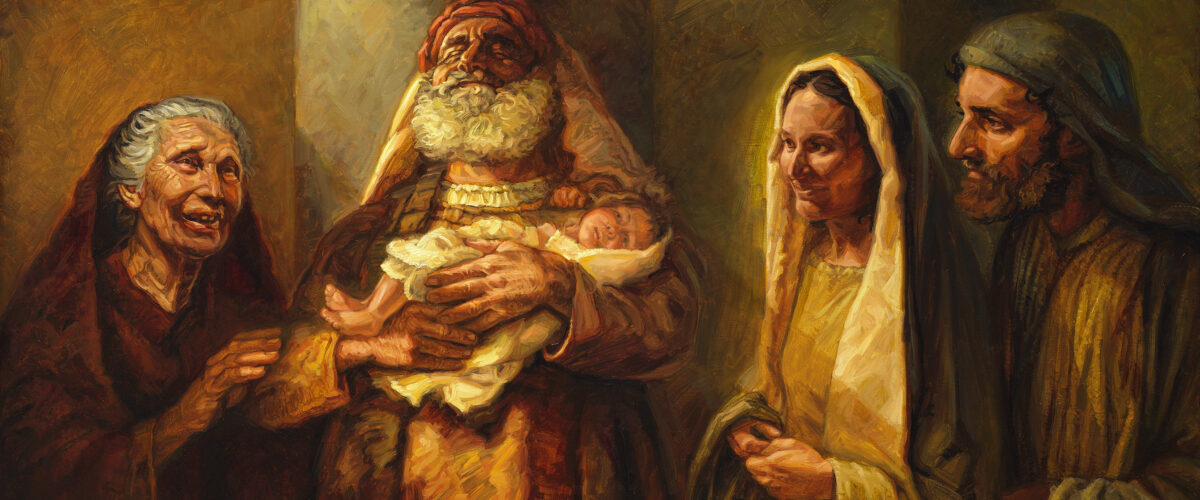
On the feast of the Presentation of Christ in the Temple the Church also invites us to reflect on the mystery of vocation and the consecrated life. The feast marks 40 days after Christmas. Mary and Joseph present Jesus in the Temple of Jerusalem in accordance with the Mosaic law. In this simple and beautiful moment, Luke not only completes the story of Christ’s nativity, he allows us to understand that the incarnation is not an abstract event but one that happens in real time and history. Jesus is born into a family, a community and a people. He is part of a tradition and the promise; like every Jewish child, he is both heir to the covenant and the one who holds it for the future. The fact that Mary and Joseph can only offer a pair of turtle doves is the mark of their poverty. It is the offering prescribed for the poor (Lev.12.8); the mark of the ‘anawim’, those whose life materially and spiritually depends completely upon God. In such details Luke begins to unfold the simplicity and poverty of Jesus’ birth; the same simplicity and poverty that will continue to mark his life and those who are called to follow.
In the Church’s tradition, the feast of the presentation is known as ‘Candlemas.’ At this feast the candles which would be used throughout the year in the liturgy were blessed. It also draws effectively upon the scriptural symbolism of the light that breaks into the darkness present in Simeon’s hymn. Simeon’s is prophetic hymn which finds many echoes in Isaiah(40-55). It bridges the Old and New Testaments and emphasises that Jesus is truly the fulfilment of God’s promise; he is ‘ the light to enlighten the Gentiles’ (lumen et revelationem gentium).
In Simeon’s hymn we hear the great song of Christian freedom which belongs to every generation; it expresses an unshakable trust in the faithfulness of God and the fulfilment of the divine promise in redemptive mercy in Christ. Like Simeon and Anna, there is a sense in which every Christian life is are fulfilled for we already know the person and the grace of Christ that has touched us. In this knowledge we are set free within history which is always haunted by the spectre of death for our eyes ‘have seen your salvation….’
With Mary, the gospel invites us to ponder the event and its symbolism. As we contemplate it, we begin to see all the subtle shades and depth of Luke’s narrative. Here, in the presentation of child Jesus, the Law is not only observed but fulfilled: the Lord has come into His temple. For Luke, salvation history is always inscribed within human history with a subversive and transformative power; it is the source of new life and possibilities, a new way of seeing and understanding so that we are never trapped within the patterns of a destructive past. Salvation history, the history which God makes for us, does not move with the great and the powerful and their values. It the way that we have come to recognise as God’s signature, it moves with the poor, who appear to have no power or influence. This is the history of the holy ones whose lives of love and sacrifice somehow keep the light alive in the darkness and whose faces we will only see in their fulness when God’s history is complete. We pass them every day in the street, and we hardly recognise them, old ones and the young ones, in Simeons and Annas, the Mary’s and Joseph’s, all those who, in some way, are filled with life of the kingdom and have dedicated themselves to it. As with crowded Temple we barely see the old ones and the little ones and yet every day we are surrounded by their holy mystery.
In the encounter between the young family and the old prophets, see how one generation preserves and hold the hope and the promise for each other. We stand in the presence of the promise fulfilled because of all those who have carried it for us. To Simeon and Ana belongs the gift of discernment; it comes through the asceticism of believing and waiting and trusting the faithfulness of God. It is in the ‘amen’ of such faithful lives that God shows Himself. With the eyes of faith they can see beyond the present in all its appearances into the future that is already present. Their faithfulness has taught them the cost of discipleship in waiting and hoping and following. Simeon sees Mary and he knows her not only in this moment but in all that lies ahead. Through his own prophet eyes of faith, the Holy Spirit lets him see beyond Mary’s present joy to the cross she will share in her own way with her son. Love does not make us immune from suffering. Mary,like all who follow Christ, has already begun to understand that to give one’s life in love is to become more deeply vulnerable. It is only in our vulnerability that we can bring the grace of the crucified and risen Christ to a world that waits in its own darkness and suffering.
Then, from this moment of encounter in the Temple, itself a sort of epiphany, we leave Simeon and Anna, and we continue with Mary and Joseph into the mystery of the hidden life. Jesus knows that he, too, must wait for it is the Father and the Holy Spirit who will determine the hour when he is ready, and his mission will begin. As with Mary and Joseph, Simeon and Anna, all the disciples of Christ know that the hidden life is the great school of faith for in it we learn to leave the initiative with God whose servants we desire to be.
II.
The Universal Call to Holiness and The Consecrated Life.
As we ‘ponder’ and contemplate the gospel of the feast of the presentation, we can also see how much it can speak to us of our own vocation, especially the vocation of the consecrated life.[1] Appropriately, Vatican II’s great constitution on the Church, Lumen Gentium, speaks of the universal call to holiness (chapter 5). Holiness is the fulfilling of the vocation that all have been given to live, as deeply as we can and in whatever circumstances life presents, the grace of Christ ‘ already the seed of eternal life (semen gloriae) in us.’[2] As this quote from Aquinas indicates, it is the life of theindwelling Holy Spirit that makes us friends of God. Lived in charity, expressed in thought, actions and word, it but comes to shape our whole life.
Our baptism confers on us all the dignity of this vocation. It locates us the particular time of our existence, within a tradition of holiness, ‘this great cloud of witness’ (Heb.12.1) which itself nourishes us and orders our lives in hope toward our life in God’s presence. In this context, and within this perspective, our lives take on a meaning, purpose and a new imagination – God’s own vision of a redeemed and flourishing world – which we could not create or sustain by our own efforts. We discover that we are summoned by grace, by the person of Christ, and he himself is our vocation and our journey’s end irrespective of our situation, age, ability, or social status.
The Christian life is the great democracy of grace in which each of us, in our unique way and person, in the community of the Church, brings the light of Christ into the world. One person’s vocation is not better or in competition with another’s; we need each vocation to enable and compliment the other. To be a father or a mother, a doctor or a teacher, a social worker or a care-giver, a religious sister or a priest. If we are responding authentically to God’s call, whatever from our vocation takes, it is a grace not only for ourselves but for others. To respond is always a response in freedom, for Christ never imposes his will but rather always enables ours.[3] When we have experienced this, whatever else we may do, or whatever else the world puts before us as the source of our meaning and value, will ultimate prove empty. Only in answering Christ’s call, in being true to him, whatever path we have to follow, we will always find companions. The call creates community for no vocation is lived alone. It creates a wonderful and graced communion in time and space; it endures throughout history until Christ comes again because this communion is the work of the Holy Spirit, “the Lord and giver of life,’ the bond of love that is life. Even when the way is difficult, or we feel our response to be poor and inadequate, we will always discover a sort of happiness which is the ever-consoling work of the Holy Spirit without whom the way would be impossible.
As Simeon saw so clearly for Mary, there is no vocation that does not at some point live out of the cross or carry it for him, for and with others. However, we live out our vocation it cannot be separate from Christ’s mission. Our vocation is our solidarity with and service of all whom Christ serves and for whom He has given His life in healing love. For each one according to the richness of the vocations the Holy Spirit shapes in the Church the light of faith – the symbol of the candle we received at our baptism – to light the way for others. As with the gospel of the feast, so much of this is lived and prayed, and undertaken in hiddenness. It is the gift which we give to the world which the world for all its knowledgedoesn’t understand and yet it is the gift by which so many may live.
It is in this context that we come to appreciate the nature of the formally consecrated life. We should not consider only as it shows itself in the great religious families of the Church, the many orders and institutes that daily manifest the beauty of the Kingdom in service of humanity which is the glory of God. Often there is a consecration or a dedication which remains private and personal but is no less effective because it is a choice to dedicate all one’s gifts and energies to the mission of Christ today. Whatever form it may take, it is truly a charismatic life which does not flee the world but finds many ways of serving in in prayer and works, in faith, hope, and love.
It is a choice, a life, which is a radical; a total response to the urgency of the Kingdom, and it witnesses to its in-breaking presence. The life that is a total surrender to the event of the Kingdom chooses the way of Christ himself in poverty, chastity and obedience. Publicly, in the vows, it puts itself completely at the service of the Church, the Body of Christ, its life and its mission. Whether lived in contemplative seclusion and prayer or in a vast number of active ministries, the consecrated life is a total life of faith that lives through love – love of God, love of neighbour and love of the Church. It lives in history but from the future that is Christ is. Such a life can often be a mystery to itself; it has to defer its own meaning and justification to Christ and his Church. It recognises that it has no meaning or future that it can bestow upon itself; it has no family, achievement or lasting monument it can claim for its own. It can only live for Christ, in humble service, waiting for that moment when He will come again. Only then will this consecrated life make sense. This life is surely a scandal for the world and for its cultures, but it is also a witness to the absolute sovereignty Christ and his victory over all that wounds, enslaves and destroys human beings, disfigures and exploits the wonderous gift of creation.
The unconditional gift of their lives, their struggles, sufferings and sacrifices, those who accept Christ’s call to a consecrated life live begin so show us something, too, of the nature of holiness. Holiness is not something removed from the world of our daily lives. It is the decision to place all that we have and are at the service of quotidian realities and struggles. It is the slow, often imperceptible work, of sanctifying the ‘now’ for it is in this moment and this place that we meet him. Sometimes we are with the carpenter at his routine work, sometimes as the teacher and healer, and, too often the crucified one. Here, we live in the hiddenness and mystery of life itself, but always in the joy of the resurrection.
This, surely, is the goal of the consecrated life. It is the goal of every vocation, every human life. With the grace of Christit is that discovery of vocation and consecration that makes us long to create a world in which everyone can have the conditions necessary to recognise their own vocation, to hear his call, and to live their life to the full.
“I don’t know Who or What put the question, I don’t know when it was put. I don’t even remember answering. But at some moment I did answer ‘Yes’ to Someone or Something and from that hour I was certain that existence is meaningful and that, therefore, my life, in self-surrender, had a goal”.
Dag Hammarskjöld, Markings
[1] See the comprehensive treatment of the consecrated life in the apostolic exhortation, Vita Consecrata, by Pope John Paul II, 1996.
[2] Summa Theologiae II-II, q. 24, a. 3
[3] Mark 10:17-3; Matthew 19:16-22; Lk. 18: 18-29. The rich young man who is sincerely searching for eternal life is also free to turn away when it calls him. In Luke he turns way but he also becomes sad for he has not only refused Jesus invitation but that of his own heart.